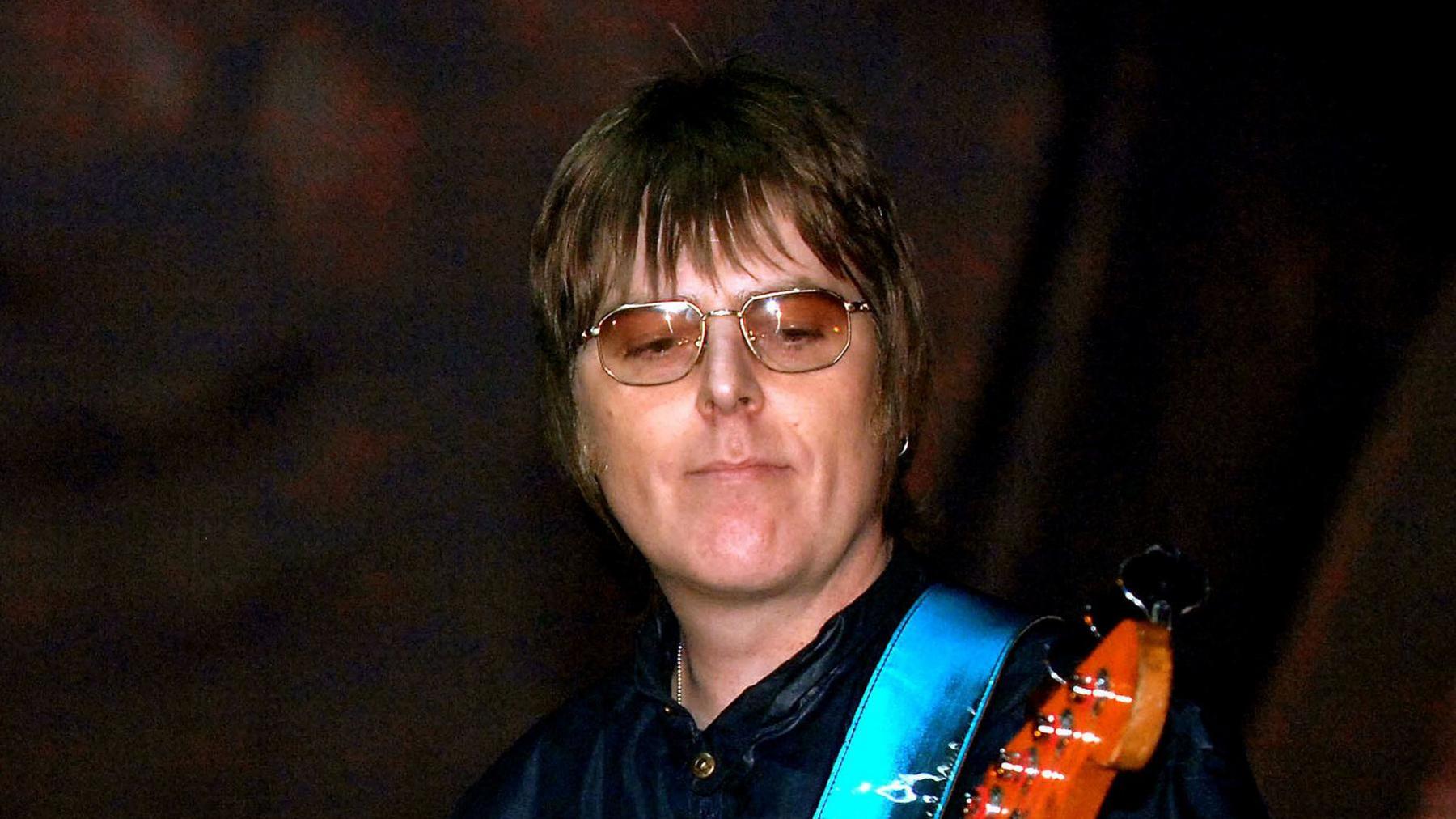
Why the Smiths' drummer says band won't reform

- Published
The Smiths drummer Mike Joyce has said he knows "the band can't reform" but would not be upset if his former bandmates joined up without him.
The 62-year-old was reflecting on his time in the band and what the future might hold in an interview with BBC North West Tonight following the release of his book, The Drums.
The musician from Fallowfield in Manchester spoke fondly of his former bandmates, Morrissey, Johnny Marr and the late Andy Rourke but said he did not think he would ever sit down and have a pint with them again.
"I know the Smiths can't reform because Andy's not here but Morrissey and Johnny, if they want to get it together and do something, fair enough," he said.
"I saw Johnny at Andy Rourke's memorial and then I saw him at the West Ham game and we had a chat and stuff and that's fine - just keep it like that."
The Smiths were formed in Manchester in 1982 and released four studio albums before breaking up in 1987.
Marr left the band a few weeks before the release of their final album in 1987, fuelled by a reported frustration with Morrissey, while the singer was said to have been equally annoyed that Marr was playing with other groups.
Joyce said the book focuses primarily on the period between 1983 and 1987 and the band's "overnight" success.
"The time that I was in the band was such an incredible experience and we were such good friends, we saw each other every day for four years," he said.
The band produced four albums in those years and toured the world, which he described as "relentless" but an "incredible experience".
"A lot of bands they start off and try to be successful but with the Smiths it was first single and bang, we we're off. It happened overnight really," he said.
He said the band's "meteoric rise" was obvious when they played Manchester nightclub The Haçienda three times in eight months to very different audiences.
"The first time there was just one woman clapping and she was one of our friends," Joyce recalled.
"Eight month later we played again and St Johns ambulance were there carrying people out fainting."
He also spoke about his "love-hate relationship" with Manchester and why the city will always be home.
"It was a very different place in the 70s, people didn't come to Manchester for the weekend, you came if you had relatives or to go to the university," he said.
"The Northern Quarter was pretty much a no-go zone because at 6pm everything shut down. You didn't really walk the streets round there."
He said he is "immensely proud" of what the city has become and he always looks forward to coming back after a tour.
"Its a beautiful place I've had a love-hate relationship with it over the years, when I was younger because it was quite a dark and foreboding place," he said.
"I've lived in London, I thought about living in Europe at one point.
"I've been around the world and I will always come back to Manchester because it's home."
Get in touch
Tell us which stories we should cover in Greater Manchester
Listen to the best of BBC Radio Manchester on Sounds and follow BBC Manchester on Facebook, external, X, external, and Instagram, external. You can also send story ideas via Whatsapp to 0808 100 2230.
Related topics
- Published29 August 2024
- Published7 December 2023
- Published22 September 2024