Should football fans be banned from games for using pyrotechnics?

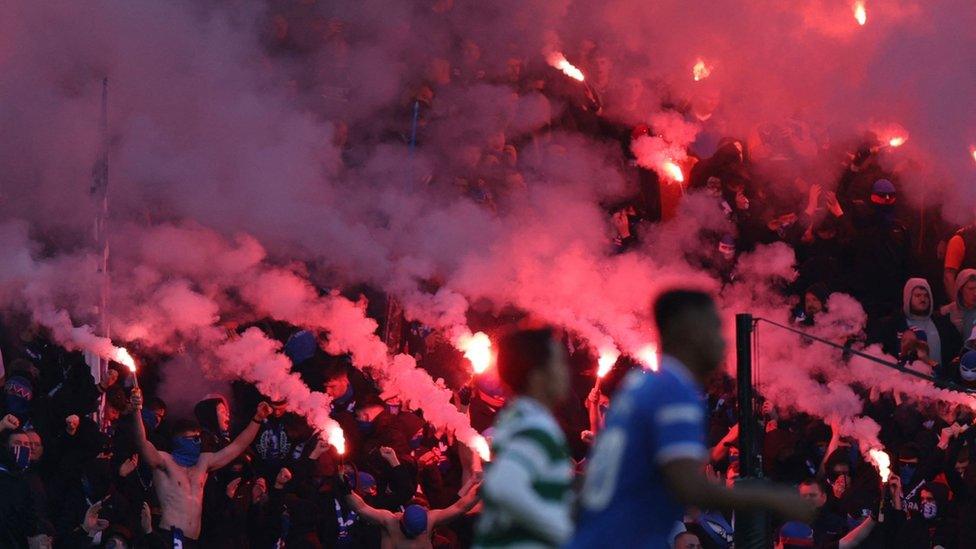
The use of pyrotechnics inside football stadiums has been increasing in recent years
- Published
The Scottish government is considering whether to extend powers to ban football fans from games for offences like using pyrotechnics and online abuse.
Currently Football Banning Orders (FBOs) are only imposed if supporters are involved in violence or disorder - they enable the authorities to stop fans attending games anywhere in the UK for 10 years.
But the Scottish government is launching a consultation on Monday to seek views on whether bans should be given out for other reasons.
The consultation, being launched by Community Safety Minister Siobhian Brown, was informed by an expert group which included football authorities, the Scottish government and police.
How often are bans currently issued?
Police Scotland data released earlier this year showed that just five bans were issued in Scotland between August and February last season.
This was down from 37 in the 2023/24 season and 59 in 2022/23.
Meanwhile a 2023 law banning possession of flares has been used infrequently.
The FBOs issued by the courts represent a fraction of those the force had requested.
For example, in 2023/24 they asked for 226 FBOs to be issued if the person they arrested was found guilty by the courts.
A total of 504 FBOs have been issued in the last decade across Scotland with Rangers and Hibernian supporters topping the table, although many of these relate to convictions for the pitch invasion after the 2016 Scottish Cup Final between the two clubs.
How much of an issue are pyrotechnics?

The most high-profile examples of fans using pyrotechnics have been at games between Celtic and Rangers
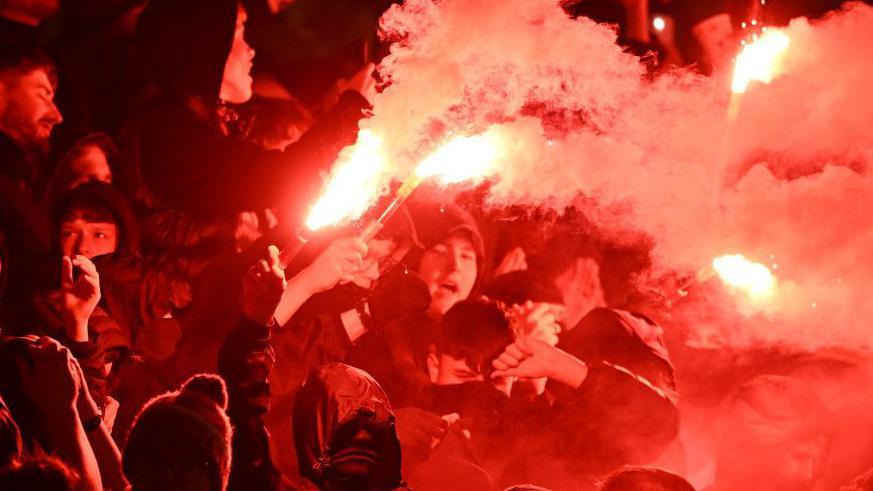
There has been an increased use of pyrotechnics at all levels of Scottish football in recent years.
Rangers and Celtic were hit with a cut in future ticket allocations as punishment for incidents involving their fans but football bosses admit "nobody has quite cracked" how to deal with the issue.
Some supporters say pyros have improved the atmosphere at games, although one survey of fans suggests that most are not in favour of them, external.
Their use has also led to serious injuries.
Is current legislation not adequate?
New legislation that made it a criminal offence to possess fireworks and flares at events such as football matches came into force in June 2023.
But its usefulness has been questioned by the Scottish government working group on pyrotechnics.
Group members noted it was "being used infrequently at football matches", adding that "there is a challenge in identifying and charging individuals who breach the legislation".
The minutes noted that the group felt the "FBO legislation does not tie in with pyrotechnics legislation".
What has the government said?

Play was stopped during a 2023 match between Dundee and Rangers because of the smoke from flares
Community Safety Minister Siobhian Brown said: "Football fans are passionate about the sport, supporting their club and, of course, our national team.
"The vast majority of supporters are well-behaved and want to enjoy football safely. However, the behaviour of a small minority can put others at risk and spoil their enjoyment of the game, and have consequences for the football club.
"Whilst we have significantly strengthened the law to tackle pyrotechnic misuse in recent years, so that those who carry fireworks and flares into football stadia can face fines and up to six months in prison, pyrotechnic misuse at games remains an issue."
She said the legislation governing FBOs in Scotland was introduced in 2006, when the use of flares at matches and "harmful social media behaviour" associated with the game were much less common.
She added: "While FBOs can already be imposed on conviction for pyrotechnics offences that involve violence or disorder, we want to hear from people whether the law needs to change so these orders could be used more widely for pyrotechnics possession and misuse - ultimately to become a more effective deterrent and keep people safe.
"We have worked with football authorities, fans' groups and justice partners on this consultation, and I would encourage anyone with an interest to give their views."
Related topics
- Published16 May
- Attribution
- Published5 March

- Published3 May 2023