Epping council loses bid over Home Office intervention

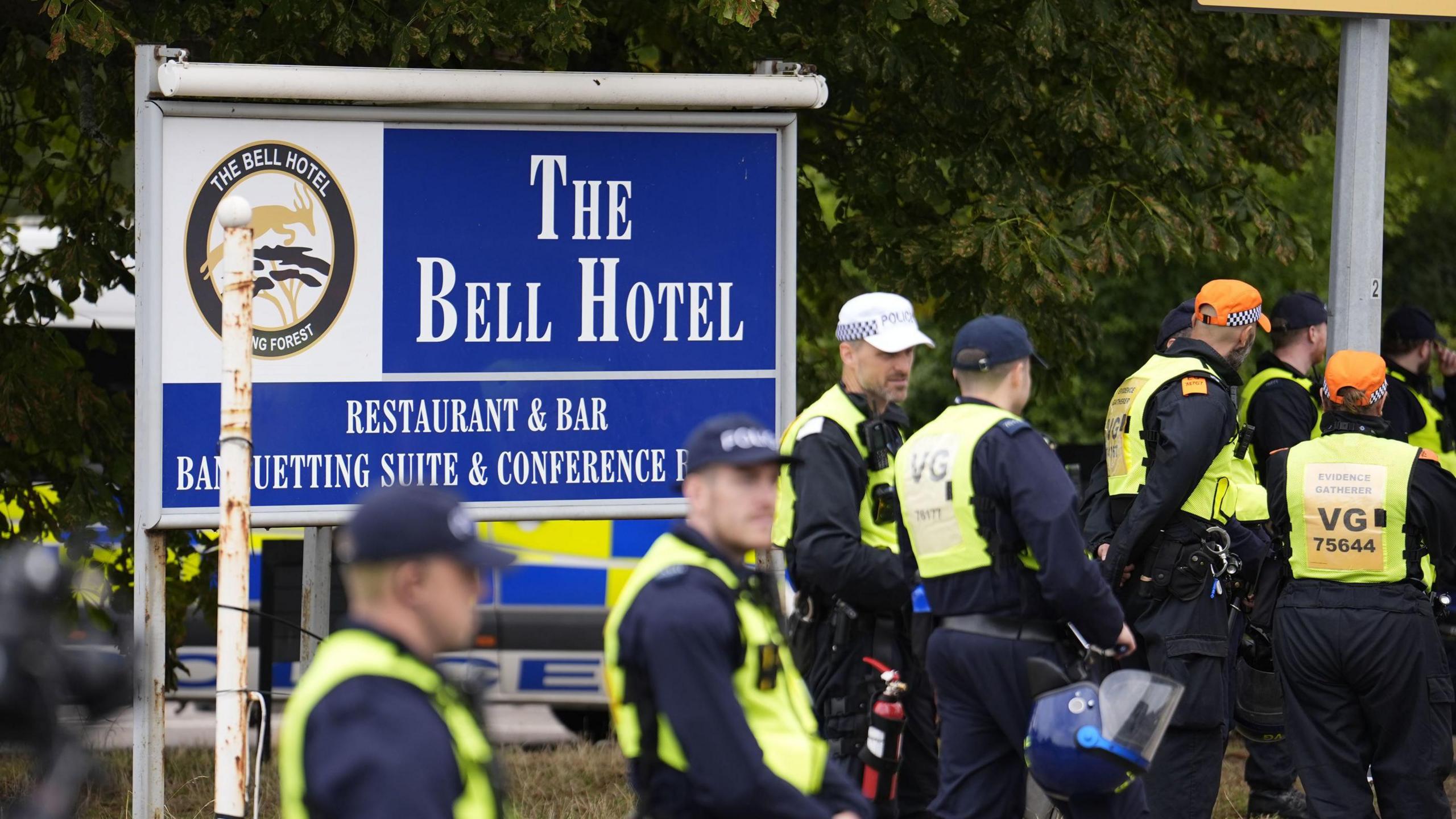
The Bell Hotel was the epicentre of intense protests and counter-protests over the summer
- Published
Epping Forest District Council cannot challenge a decision to allow the Home Office to intervene in its unsuccessful bid to block asylum seekers staying at a hotel, the Supreme Court has ruled.
The local authority won an emergency interim injunction to close the Bell Hotel in Epping to migrants in August and a ruling that the Home Office could not intervene - but this was overturned by the Court of Appeal.
The Supreme Court decision comes just weeks after the council saw its bid for a permanent injunction dismissed earlier in November.
Giving the reasons for the refusal, the Supreme Court website said: "The application does not raise an arguable point of law of general public importance."
The Bell Hotel in Epping became a focal point of a series of protests and counter-protests over the summer after an asylum seeker living there was arrested - and later convicted and deported - for the sexual assaults of a teenage girl and a woman.

Protests and counter-demonstrations were staged outside The Bell Hotel in Epping during the summer
The council had argued that the Court of Appeal was wrong to allow the Home Office to intervene in the case.
However, on Monday, the Supreme Court announced the decision was refused by Lord Reed, Lord Leggatt and Lady Simler.
At the High Court in November, Mr Justice Mould dismissed the council's claim that housing asylum seekers was a breach of planning rules.
The judge ruled an injunction was "not an appropriate means of enforcing planning control".
Lawyers for the authority had argued that the housing of asylum seekers is a "material change of use" and has caused "increasingly regular protests".
While barristers for hotel owners Somani Hotels said it "firmly disputed" the council's claim, while the Home Office told the court that the authority's bid was "misconceived".
The council announced last month it would appeal against Mr Justice Mould's ruling, following a vote by councillors.
The Bell has been used to house single adult males since April, and first housed asylum seekers from May 2020 to March 2021.
It accommodated single adult males from October 2022 to April 2024, during which the council took no enforcement action.
The High Court heard that the company applied for planning permission for a "temporary change of use" in February 2023, but later withdrew the application as it had not been determined by April 2024.
Get in touch
Do you have a story suggestion for Essex?
Follow Essex news on BBC Sounds, Facebook, external, Instagram, external and X, external.
- Published6 days ago

- Published11 November
- Published12 November