Which are the best west coast ferries to spot whales and dolphins?

Scotland's waters provide habitat to a range of species, including bottlenose dolphins
- Published
Ferry passengers on Scotland's west coast often celebrate spotting wildlife in the waves as they travel between the Hebdrides and the mainland.
But conservationists also use the network of CalMac ferry routes to gain insight into the lives of native whales and dolphins.
For six months every year volunteers from the charity ORCA carry out surveys from the boats.
The results of this year's research show which species are making their homes in Scottish waters and which ferries people are most likely to spot them from.
Where are CalMac's ferry routes?

The publicly-owned ferry company operates in the Firth of Clyde, Argyll and Bute and the Western Isles.
Its boats sail to about 30 destinations, including Arran, Lewis and Harris, and the tiny isle of Eigg in the Small Isles.
Almost 40 ORCA volunteer marine mammal surveyors were involved in 37 surveys that were carried out between March and October across seven different routes.
A few surveys were cancelled due to bad weather, and no studies were done on the Ardrossan-Campbeltown route.
CalMac said ORCA still managed to conduct the most surveys on the highest number of different routes since the studies started in 2017.
Volunteers travelled a total distances of 3,423 miles (5,509km) during the research.
Which species were spotted from the ferries?
- Image source, Orca
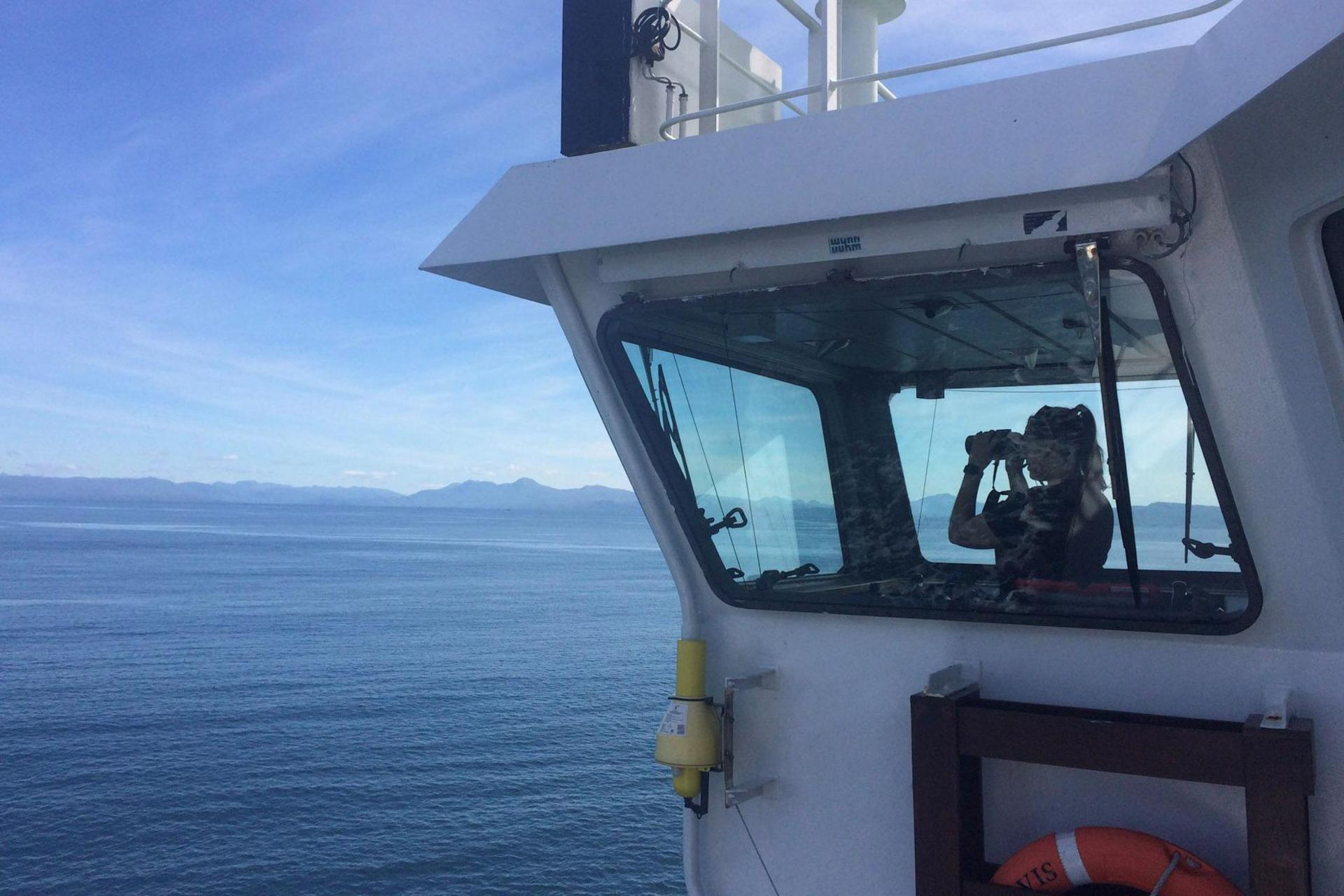
Image caption, ORCA and CalMac have been working together on the annual surveys since 2017.


1 of 4
This year's survey recorded 1,589 individual animals - almost double that of 2024.
ORCA said this could be because of the increased effort made in 2025 to spot sea life.
Ten different marine species were seen - two less than last year - and they included whales, dolphins, porpoises, seals and sharks.
Common dolphins were the most frequently recorded, with 1,147 individual animals seen.
This was more than double the number recorded in 2024.
There was also an increase in minke whales sightings - 73 in 2025 compared with 20 in 2024.
ORCA said the rise in both common dolphins and minke sightings could be because of climate change, with the species finding "more favourable" conditions further north around the Hebrides.
It said further research would be needed.
Harbour porpoise, bottlenose dolphin and common seal were among other animals spotted.
Which CalMac routes are best for seeing dolphins, seals and whale?

CalMac sails to about 30 destinations on Scotland's west coast
ORCA said the "high density" marine wildlife areas seem to have shifted north to the Uig-Lochmaddy-Tarbert and the Ullapool-Stornoway routes - a trend first noticed last year.
On Uig-Lochmaddy-Tarbert, minke whale were spotted and 25 common dolphins swimming together in a "super pod".
On the route between Ullapool and Stornoway, there was an occasion when 13 harbour porpoise were seen.
Spotted on the route at various times were common dolphin super pods numbering between 13 and 30.
The species, which hunt squid and fish including herring and mackerel, were also seen bow riding - swimming in groups in front of ferries.
However, the Oban-Castlebay route recorded the most species.
They included harbour porpoise, common dolphin, minke whale and grey seal.
On another route - Oban to Tiree - 30 sightings of harbour porpoise were seen across the survey.
These animals are described as shy and make a "chuff" sound when they come to the surface to breathe.
ORCA said: "Very excitingly a pod of five orcas were seen on the Uig-Lochmaddy-Tarbert route.
"The most productive surveys were the July and October Ullapool-Stornoway surveys, where more than 100 animals were recorded on each survey."
Other organisations also survey Scotland's sea life, including the Hedridean Whale and Dolphin Trust and Whale and Dolphin Conservation.