Childminders on moving beyond the living room

Childminders can now operate in community hubs such as schools and churches
- Published
Childminders play a vital role in the UK's childcare ecosystem, offering nurturing and flexible home-based care that often suits parents with non-traditional working hours.
But with the number of registered childminders rapidly declining, will a new scheme to allow them to operate from schools and community centres instead of their own homes for the first time work?
"I love it. I love the chaos. I love the freedom of the children learning. I even love changing the bums."
Victoria Cook has worked as a childminder for more than 10 years.
"We're not just babysitters - we're educators, carers, and part of the community," she said.
"If we disappear, families lose more than just childcare, they lose choice."
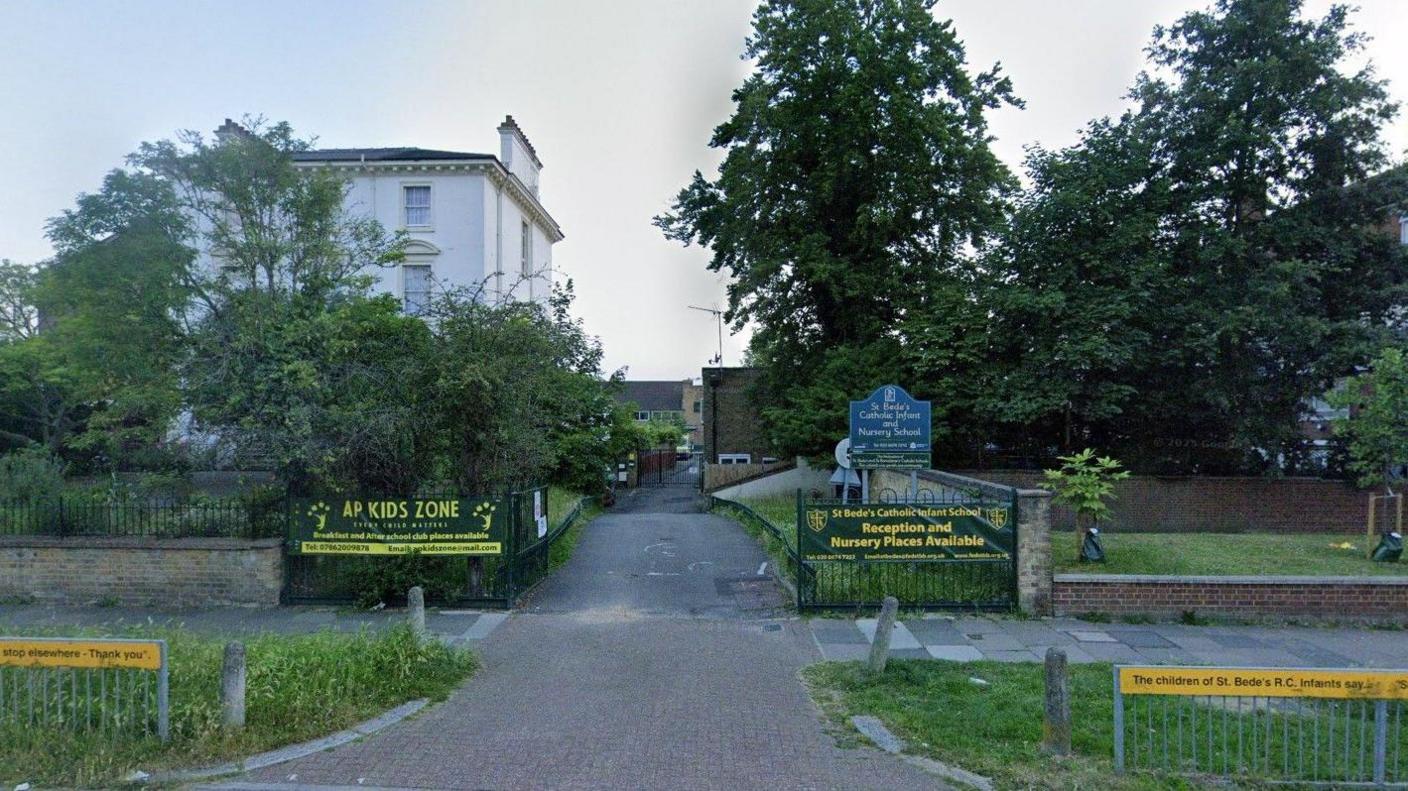
Recently, she has relocated her business from her home to a school in Pimlico which closed last year due to falling pupil numbers - an increasing issue in central London.
"It's really nice not to be working at my own home and to be working in the new setting," she said.
"We've got so much more opportunity here; we've got a bigger setting, we can do a lot more things.
"I've got the flexibility of taking on more staff and increasing the ratio of children," she added.

Victoria Cook says the move to a school building has transformed her business
The new flexibility comes amid a steep decline in the number of childminders.
According to Ofsted, there were about 38,000 registered childminders in 2020 but by 2023, that number had dropped by 26%, with a further 5% decline recorded in the past year. If the trend continues, some fear the profession could disappear entirely by 2033.
Rising costs, administrative burdens, and the isolation of working alone are some of the reasons given for the exodus. Many childminders also cite a lack of recognition and low pay as key challenges.
The problem is particularly acute in London where childminders are priced out of homes that are of a suitable size and it is an extra barrier to persuade landlords to allow them to run their business from a property they are renting.
Childminders play a vital role in the UK's childcare ecosystem, offering flexible, home-based care that often suits parents with non-traditional working hours. They are also praised for providing nurturing, personalised environments that support early development.

Rebeka Fisher (left) and Laura Thoeling are setting up their business in a church
Rebeka Fisher and Laura Thoeling are hoping to buck the trend having just secured a childminding setting in a church in Essex along with another nanny.
"We're super excited to take advantage of the rule change because we love working with children and there's definitely a strong demand for our services," they say.
"We're moving from being nannies to opening our own childminding business because we believe it really does take a village to raise a child, and we want to create a safe, supportive space for both children and parents."
But the process of finding somewhere has been difficult and they say more support is needed to encourage more people to become childminders.
"Finding a suitable property has been one of the hardest parts - we were rejected by around 50 places, and it took almost a year to finally secure a premise.
"It would be great if there was more support with finding a place or if more landlords were open to childminders operating from their properties."

Ofsted has reported a 5% decline in childminders in the past year
Tiney, an agency that supports 1,300 childminders caring for more than 8,000 children across the UK, say the premises change could help unlock a wave of new talent.
"A lot of people who would make excellent educators, often with early years experience, simply couldn't become childminders because their housing situation didn't allow it," spokesperson Sarah Silver said.
Future Academies, which runs 11 schools across London and the South East, is partnering with Victoria and others to make use of underutilised school spaces.
"There are a lot of schools which are now under roll," its chief executive Lawrence Foley said.
"This is a really simple way to use that space productively. It needs more central government energy, but also a bit of boldness from schools and trusts."

Parents say they value the benefits of childminders
For many families, particularly in London, the most expensive region for childcare in the UK, the shift is a welcome one.
"Childminders seemed to be quite few and far between these days," said Rob whose daughter is looked after by a childminder.
"We always wanted a childminder because of the one-to-one approach."
David, another parent, praised the warmth and familiarity of his childminder's new premises: "It feels like an extension of a home.
"With a childminder, you become part of the family. The door's always open."
A Department for Education spokesperson said: "Childminders provide flexible, high-quality care that families value and we recognise the pressures many of them face.
"As we deliver our Plan for Change, we're backing the sector with over £8bn in funding this year, including an increase in rates while we're expanding school-based nurseries and Best Start Family Hubs, and the workforce has grown significantly.
"Childminders can use funding flexibly across the children they look after - it isn't tied to one age group - and many could benefit from growing demand for places."
Listen to the best of BBC Radio London on Sounds and follow BBC London on Facebook, external, X, external and Instagram, external. Send your story ideas to hello.bbclondon@bbc.co.uk, external
Related topics
Related internet links
- Published18 February

- Published3 July