Summary

  1. Six key findings in the police watchdog's Hillsborough reportpublished at 13:38 GMT
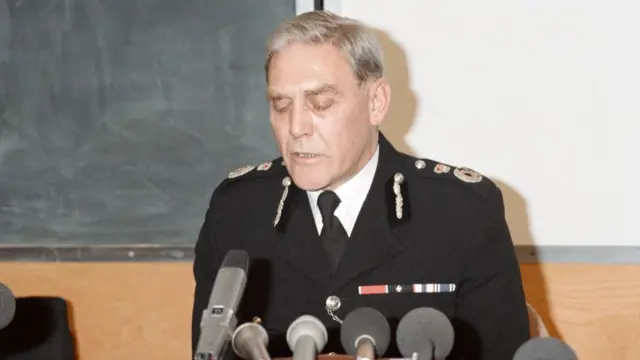
    Former South Yorkshire Police (SYP) chief constable Peter WrightImage source, Getty Images
    Image caption,

    Former South Yorkshire Police chief constable Peter Wright would have faced a case of 10 alleged breaches of the police disciplinary code, the report finds

    Here's a summary of six of the key findings from the IOPC's 366-page report:

    • Twelve police officers would have faced gross misconduct hearings - but now won't because of the law at the time
    • The report finds "fundamental failures" on the day of the disaster, and "concerted efforts" to blame fans. It also upholds or finds cases to answer for misconduct in 92 complaints about police action
    • Former Ch Supt David Duckenfield, who was match commander on the day, would have faced 10 alleged breaches for "failures in decision making and communication in relation to managing the build-up to the game", as well as a "series of key failings of control as the crowd built"
    • Former SYP chief constable Peter Wright would have faced a case over 10 alleged breaches of the Police Disciplinary Code regarding his actions in the aftermath of the disaster
    • South Yorkshire Police (SYP) "fundamentally failed" in planning for the match and in its response - attempting to "deflect the blame" while dealing with traumatised supporters and families
    • As part of this response, 327 statements from officers - 100 more than previously uncovered - were found to have been amended

    Read more: Officers would have faced misconduct over Hillsborough
  2. Report is stark reminder of significant policing failure, says home secretarypublished at 13:31 GMT

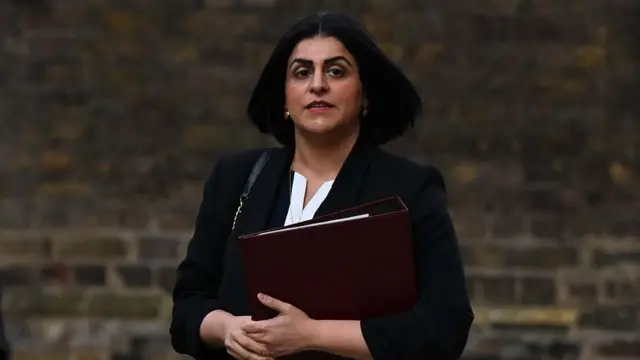
    Shabana MahmoodImage source, Getty Images

    Home Secretary Shabana Mahmood says today's report "serves as a stark reminder of one of the most significant failings in policing the country has ever seen".

    She pays tribute the families and survivors of the disaster, saying: "They have faced years of mistreatment and delay, but thanks to their tireless campaigning we are introducing the Hillsborough Law which will place a legal duty of candour on public servants and authorities."

    "There is also now legislation in place which means that police officers cannot evade misconduct proceedings by retiring or resigning, so these failings can never be repeated."

  3. 'It is wholly unsatisfactory that we are still looking for answers,' says police watchdog deputypublished at 13:24 GMT

    Roger Johnson
    BBC North West Tonight presenter

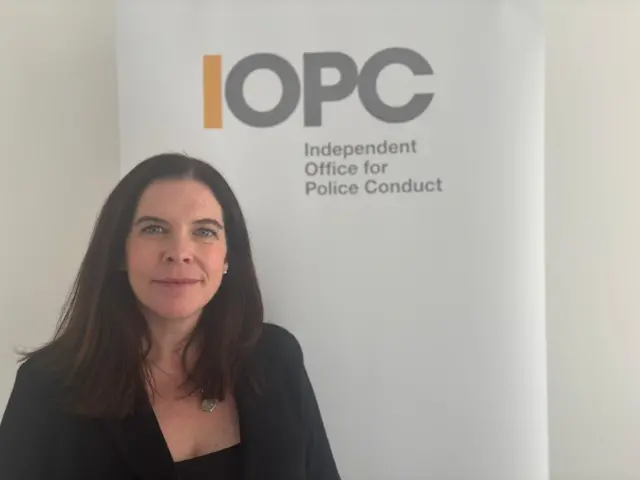
    Kathie Cashell, who has long brown hair and wears a black blazer over a black top, smiles at the camera in front of a sign reading IOPC.Image source, Claire Hamilton/BBC

    Ahead of the report's publication, IOPC deputy director-general Kathie Cashell said the victims, their families and survivors had been “repeatedly let down” by the "deep complacency" of South Yorkshire Police

    This, she said, was in the force's preparation for the match, its response to the unfolding disaster, and its "concerted efforts" to deflect blame onto Liverpool supporters.

    Since 2012, the IOPC investigation has cost around £80m, and some families of those who died at Hillsborough have questioned its value, considering no individual officers will face sanctions.

    Asked about those comments, Cashell told the BBC: "Obviously, I'm very disappointed to hear that."

    She said the investigation had supported the fresh inquests in 2016, which returned verdicts of unlawful killing.

    "What I think is at the heart of all of this is the lack of candour at the outset and the defensive approach by, particularly, South Yorkshire Police to the inquiries that happened after the disaster," she said.

    Cashell added: "That lack of candour at the time I think really shows what the impact can be when organisations prioritise defending their reputation over admitting mistakes and putting things right.

    "It is wholly unsatisfactory that we all are, some 36 years later, still looking for answers."

  4. South Yorkshire Police chief apologises for 'litany of failures'published at 13:17 GMT

    The chief constable of South Yorkshire Police says she fully accepts the findings published in today's report.

    "There is nothing I can say today which can take away the years of pain and hurt caused by the force I now lead," says Chief Constable Lauren Poultney.

    "On behalf of South Yorkshire Police, I fully accept the IOPC report which highlights a litany of failures and am so deeply sorry for the pain and heartache caused," she says.

    Poultney adds that the force "failed" those at the football match, "and also failed their loved ones in the days, months and years after."

    "This will always be a point of deep regret and shame for South Yorkshire Police," she says.

  5. Bereaved families have had 'accountability denied', lawyer sayspublished at 13:11 GMT

    A lawyer representing several bereaved families says it's a "bitter injustice" that no police officer will be held to account by today's Independent Office for Police Conduct (IOPC) report.

    Nicola Brook, a lawyer at Broudie Jackson Canter, says while this outcome vindicates bereaved families' fight, "it delivers no justice".

    "Instead, it exposes a system that has allowed officers to simply walk away, retiring without scrutiny, sanction or consequence for failing to meet the standards the public has every right to expect," she says.

    Brook notes that the law has since changed, but says the families "are left with yet another bitter injustice: the truth finally acknowledged, but accountability denied".

  6. The 12 officers named in the reportpublished at 13:07 GMT

    Jonny Humphries
    Live reporter

    The police watchdog's report has named 12 officers who would have faced gross misconduct allegations - 10 from South Yorkshire Police (SYP) and two from West Midlands Police (WMP) - the force appointed after the disaster to investigate the conduct of SYP.

    As we've been reporting, the law at the time means no officers will face sanctions, because they had all retired before investigations began.

    The ten officers from SYP are:

    1. Chief Constable Peter Wright - Six allegations relating to efforts to deflect blame towards Liverpool fans
    2. Assistant Chief Constable Walter Jackson - Two allegations relating to failing to adequately plan for the match and failing to organise and direct junior officers to help save lives
    3. Ch Supt David Duckenfield - 10 allegations around failing to adequately plan for the match, failing to respond to the unfolding disaster and lying about his order to open Gate C
    4. Supt Bernard Murray - Five allegations around failing to plan adequately and failing to respond effectively to the unfolding disaster
    5. Supt Roger Marshall - Two allegations around failing to control the flow of supporters and wrongly calling for gates to be opened to relieve the pressure outside the ground
    6. Ch Insp Norman Bettison - Two allegations of dishonesty over his role in the disaster while applying for a job as Chief Constable at Merseyside Police in 1998, and also providing misleading press statements
    7. Det Ch Insp Alan Foster - One allegation of pressuring SYP officers who refused to make alterations to their original accounts of what happened that day
    8. Insp Harry White - One allegation of failing to manage the build up of the crowd in the inner concourse and his subsequent response
    9. Sgt John Morgan - Two allegations of being absent from his area of responsibility and failing to take action after Gate C was opened at 14:48 GMT
    10. Supt Roger Greenwood - One allegation that he failed to respond to events in Pens 3 and 4 and failed to organise junior officers to help save lives

    From WMP, the two officers are:

    1. Assistant Chief Constable Mervyn Jones - Four allegations of failing to effectively investigate SYP and bias towards the force, and against supporters
    2. Det Ch Supt Michael Foster - Six allegations along similar lines
  7. Twelve officers would have faced gross misconduct cases over Hillsborough, report sayspublished at 13:00 GMT
    Breaking

    Jonny Humphries
    Live reporter

    Twelve former police officers would have faced gross misconduct proceedings for "fundamental failures" on the day of the Hillsborough disaster and "concerted efforts" to blame fans in the aftermath, according to a report by the police watchdog.

    The Independent Office for Police Conduct (IOPC) upheld or found cases to answer for misconduct in 92 complaints about police actions relating to Hillsborough.

    But the law at the time means no officers will face sanctions, because they had all retired before investigations began.

    The report says the 12 officers facing disciplinary proceedings would have included former South Yorkshire Police Chief Constable Peter Wright - who has since died - for his attempt to "deflect blame" towards Liverpool supporters.

    The list also includes match commander Ch Supt David Duckenfield, who the report says would have faced 10 allegations - including that he failed to plan adequately to prevent the disaster, failed to respond when things began to go wrong and "failed to act when people were in distress".

  8. Analysis

    Families and survivors increasingly disappointed by processpublished at 12:51 GMT

    Judith Moritz
    Special correspondent

    When the Independent Police Complaints Commission (IPCC) set up its investigation into Hillsborough in 2012, hopes were riding high.

    The families bereaved by the disaster, and the thousands who survived it, were daring to feel optimistic for the first time in more than 20 years.

    An Independent Panel had just published a report which shed new light on the 1989 tragedy. It exposed the scale of the failed policing which caused the crush; the mess made of the emergency response; and the cover-up which followed.

    As a result of this, millions of pounds were ring-fenced for two brand new investigations. There was a real sense of purpose.

    But the optimism felt by families and survivors at the beginning began to ebb away.

    The IPCC changed into the Independent Office for Police Conduct (IOPC), years passed, and criminal trials ended without significant convictions. The families started to lose faith in the process.

    Often they would tell me there was no point to it. They knew that all of the police officers involved had either retired or died. Even if they were found to be guilty of misconduct, no sanction could be imposed.

    Then, they started to realise that even that outcome may be a stretch.

    Last autumn, the IOPC started sending letters out to families and survivors whose complaints had been investigated. Many had not been upheld. There was not enough evidence to support the complaints, they were told.

    I have stayed in touch with the families and survivors over the years since and have watched as their sense of disappointment and deflation has grown.

    They were so full of hope a decade ago. But I am yet to find one who feels that way now.

  9. A timeline of the Hillsborough disaster and the decades-long fight for justicepublished at 12:46 GMT

    People hold football scarves at a vigil at St George's Hall in LiverpoolImage source, Getty Images

    15 April 1989: A fatal crush in the Liverpool supporters' end at Sheffield's Hillsborough ground sees 97 die and hundreds more injured. Liverpool fans are immediately blamed in briefings by South Yorkshire Police.

    1989-91: A judicial inquiry and inquests are held. Criminal charges against Sheffield Wednesday football club, Sheffield City Council, and stadium safety engineers are ruled out.

    2000: Hillsborough families bring private prosecutions against the senior police officer in charge at Hillsborough, David Duckenfield, and ground controller David Murray. There are no convictions.

    2009-12: Hillsborough Independent Panel (HIP) is created to review previously unseen evidence. Its damning report on the emergency response earns a formal apology from then-Prime Minister David Cameron.

    2013: Two fresh criminal investigations are launched and IOPC investigation begins.

    A vigil is held in Liverpool in 2016Image source, Getty Images
    Image caption,

    A vigil was held in Liverpool after the coroner's verdict in 2016

    2014-16: New Warrington inquests become longest in legal history, lasting two years. A court rules that those who died were unlawfully killed as a result of David Duckenfield's actions and that the fans were not to blame for the crush.

    2019: More criminal trials take place. David Duckenfield is acquitted of gross negligence manslaughter.

    October 2025: Government introduces the Hillsborough Law, which will force public bodies to cooperate fully with investigations or potentially face criminal sanctions.

    2 December 2025: IOPC's police misconduct investigation publishes its final report.

  10. 'We've been through hell and back' - bereaved families share thoughts ahead of reportpublished at 12:28 GMT

    Short haired woman sits on sofa as she looks to camera
    Image caption,

    Debbie Matthews gave evidence at the inquest. Her brother Brian was one of those killed at Hillsborough

    Charlotte Hennessy was only six years old when her father, James, was killed during the Hillsborough disaster.

    She says the length of the investigations, as well as the original cover-up, has resulted in Hillsborough haunting her adult life.

    "The process has been extremely lengthy and I have no doubt it will only leave us feeling frustrated," she says.

    "We want to be able to live our lives but we keep getting pulled back into this."

    Debbie Matthews, whose brother Brian was killed at Hillsborough, made two complaints alleging that officers had fabricated evidence and given false statements. She says one was not upheld while the other was deemed outside the scope of the investigation.

    "We've already been through hell and back and it feels like they are kicking us again," says Debbie.

    Jenni Hicks, whose teenage daughters Sarah and Victoria died at Hillsborough, says she is "not expecting any great revelations" from the report, and would have preferred families to see the longer version before any decision to publish it.

    "I hope it's not going to be a waste of taxpayers' money," she says.

  11. Investigation analysed stacks of police notebooks and VHS cassettespublished at 12:21 GMT

    Judith Moritz
    Special correspondent

    When this investigation into the Hillsborough disaster was launched in 2012, hundreds of staff were recruited to take part.

    A huge office block in Warrington was leased to house them, plus a temperature-controlled archive store, and state-of-the-art technical facilities.

    The stakes were high. “We have to succeed”, the investigation’s first director Deborah Glass told me. She was aware that part of her team’s remit was to put right the wrongs of the past.

    In 2016 I was invited to watch the investigation team at work.

    Stacked on shelves in the archive store, I saw piles of notebooks. They were the original pocket books belonging to the rank and file police officers who’d been at the Sheffield disaster.

    I assumed they had been carefully preserved by South Yorkshire Police. In fact, I was told, they had spent 25 years in a lock-up, and some had to be cleaned of rat droppings before they were suitable for analysis by the new investigation team.

    The investigators had another hurdle to clear too. They had acquired boxes of VHS cassettes and floppy disks which contained more documentary evidence. But they were useless until the team managed to bring some 1980s tape machines and computers back to life, to render them watchable again.

    In another room, modern technology was on show. Facial recognition analysis was used to track the movements of each of the Liverpool fans in the crush, to find out more about their experience on the day.

    This is the largest ever investigation conducted by the police watchdog.

    At its height 200 staff were on the books. It provided evidence for the two-year-long Inquests which ran in Warrington between 2014 and 2016, and generated evidence for two sets of criminal proceedings.

  12. How did we get here?published at 12:11 GMT

    Jonny Humphries
    Live reporter

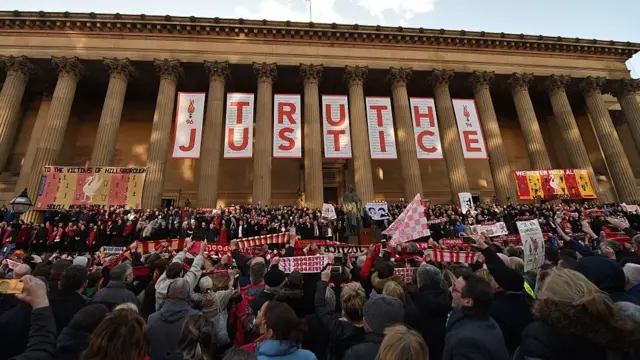
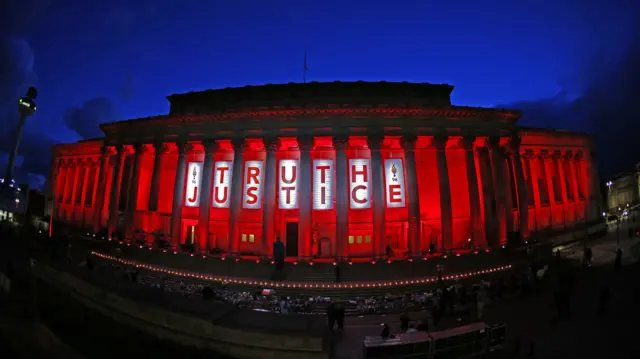
    A banner reading 'Truth Justice' in red lettering hanging on the pillars of St George's Hall in Liverpool, which is illuminated redImage source, PA Media

    The process that led to the police watchdog investigation began with the publication of the landmark Hillsborough Independent Panel (HIP) report, published in 2012.

    The HIP - commissioned three years earlier - laid bare the litany of police failings that led to the deadly crush in the Leppings Lane end of Hillsborough Stadium in 1989 - and the decades long cover-up that followed.

    It also exposed major problems in the way the original set of inquests - held between 1990-91, and reached a conclusion of accidental death - were carried out.

    The coroner overseeing that hearing, Dr Stefan Popper, said it should only investigate events before a 15:15 cut-off time, based on the false belief that injuries were fatal by that time. It therefore excluded evidence of events afterwards.

    After HIP published its report in 2012, those inquest findings were quashed, a major new criminal investigation - Operation Resolve - was commissioned by the government.

    The police watchdog also opened its own investigation into police conduct, alongside Operation Resolve.

    Both investigations provided evidence to a new set of inquests held between 2014 and 2016, which went on to find that the victims had been unlawfully killed.

    Today's report is intended as the final word on both Operation Resolve's findings and the Independent Office for Police Conduct (IOPC)'s own investigation - although it has already been confirmed that no individual officers can face sanctions, as all have since retired or died.

    For many of the Hillsborough families, deep frustration remains at both the lack of individual accountability and the length of time it has taken to get here.

  13. How the 1989 Hillsborough disaster unfoldedpublished at 12:03 GMT

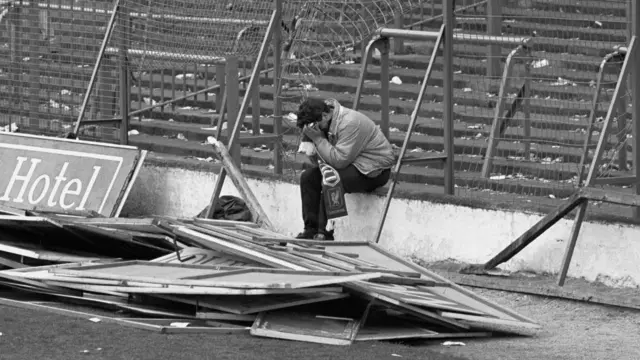
    A Liverpool fan sits on the steps at Hillsborough surrounded by debrisImage source, PA Media

    On a sunny afternoon in April 1989, Liverpool fans gathered at Hillsborough Stadium in Sheffield for an FA Cup semi-final against Nottingham Forest.

    There were 10,000 tickets for Liverpool fans on the standing terraces, who had seven turnstiles to enter through. At 14:00 - with an hour to go until kick-off - nearly 8,000 supporters were yet to make their way inside.

    As kick-off approached, a large crowd built up outside the Leppings Lane turnstiles. Following an urgent request to relieve the pressure, match commander Ch Supt David Duckenfield gave the order to open an exit gate.

    He also decided against delaying the scheduled kick-off time of 15:00.

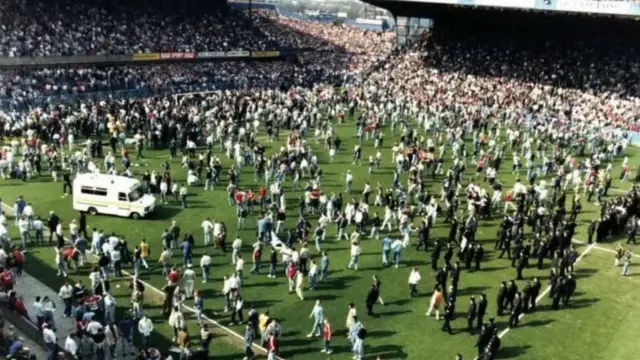
    Two thousand Liverpool fans entered via a tunnel on to the already-packed terraces, bordered by high fences. Barriers began to break and people fell forwards. Some escaped by climbing over fences as the match begun.

    A severe crush developed in the central pens and people were pulled out in a "human cascade". The fixture was postponed at 15:06, as supporters tumbled onto the pitch.

    Ninety-six men, women and children lost their lives with hundreds more injured. The oldest victim was 67, the youngest just 10 years old.

    Thirty two years later, 55-year-old Andrew Devine, who suffered life-changing injuries in the crush, died. A coroner ruled that he had been unlawfully killed, making him the 97th victim of the Hillsborough disaster.

  14. Police watchdog to publish Hillsborough report into police conductpublished at 12:00 GMT

    Jonny Humphries
    Live reporter

    Thousands of fans stream onto the pitch at Hillsborough Stadium. On the right of the frame, by the half-way line,is a line of police officers in black uniform, and on the right a single ambulance drives onto the pitch.Image source, Hillsborough Inquests

    Today is the culmination of a vast amount of work - and taxpayer's money - spent over 13 years of investigations by the Independent Office for Police Conduct (IOPC).

    A report, detailing police conduct surrounding the stadium crush, is due to be released later today - at 13:00 GMT.

    It is expected to be the official final word on the actions of South Yorkshire Police and West Midlands Police before, during and in the years after the Hillsborough disaster.

    Families and survivors have mixed views about it's relevance, however, with some warning it "may not give answers".

    Due to legislation around police misconduct proceedings at the time, no individual officers can face disciplinary action - as all have since retired or died.