Summary

  1. Legal experts weigh in on second US strike on alleged drug boatpublished at 15:20 GMT

    Thomas Copeland
    BBC Verify Live journalist

    A second strike on an alleged Venezuelan drug boat was ordered by US Navy Admiral Frank Bradley, the White House has confirmed.

    The Washington Post recently reported that two people survived the first blast and were clinging to the burning vessel when they were killed by the second strike.

    Legal experts have told BBC Verify that this second strike was probably illegal under international and US law.

    The White House also confirmed that Defence Secretary Pete Hegseth had authorised the operation to target the boat, but denied Washington Post reports he had given an order to "kill everybody" on board.

    The White House said Admiral Bradley “worked well within his authority and the law".

    Media caption,

    White House defends Venezuela boat strikes, says Admiral Bradley acted legally

    If Hegseth did issue an order to "kill everybody", then this would amount to declaring “no quarter” - meaning to leave no survivors - which Prof Luke Moffett says is itself illegal.

    Following orders is no defence to criminal acts, he says. The Queen’s University Belfast expert adds there is a “long history” of war crimes convictions for soldiers over following illegal orders, including German soldiers at the Nuremberg trials after WW2.

    Prof Michael Becker of Trinity College Dublin also says that regardless of how Hegseth worded his order, there is a “presumption that orders are meant be interpreted in accordance with the law”.

    He says that “strictly speaking, this may put the burden” of responsibility on Admiral Bradley.

  2. Are there significant backlogs in magistrates’ courts?published at 14:56 GMT

    Anthony Reuben
    BBC Verify senior journalist

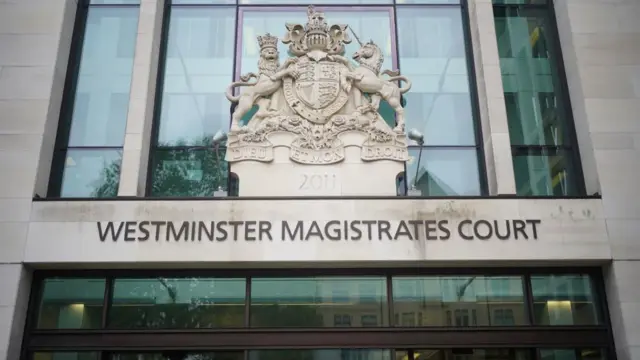
    The exterior of Westminster Magistrates Court in central LondonImage source, PA Media

    Justice Secretary David Lammy has been telling MPs in the House of Commons about his plans to end jury trials for some offences in England and Wales. That move would affect court courts, where there is a backlog of cases.

    When it comes to magistrates’ courts, where less serious criminal offences are tried, Lammy told BBC Radio 4 earlier that “we have not got significant backlogs“.

    If you look at the latest court statistics, external for England and Wales, the number of open cases at magistrates’ courts was at a record high of 361,027 at the end of June.

    The release says that the number of new cases being received and the number being dealt with had both increased compared with the previous year, but that new cases had risen faster.

    Law Society of England and Wales vice president Brett Dixon disagreed with Lammy, saying: “There is already a significant backlog in the magistrates’ courts.”

    And he expressed concern that the justice secretary’s plans could “simply be shifting the Crown Court backlog to the magistrates’ court backlog”.

  3. Satellite images show worsening water crisis in Iran’s capitalpublished at 14:24 GMT

    Ghoncheh Habibiazad, Alex Murray and Shayan Sardarizadeh
    BBC Persian and BBC Verify

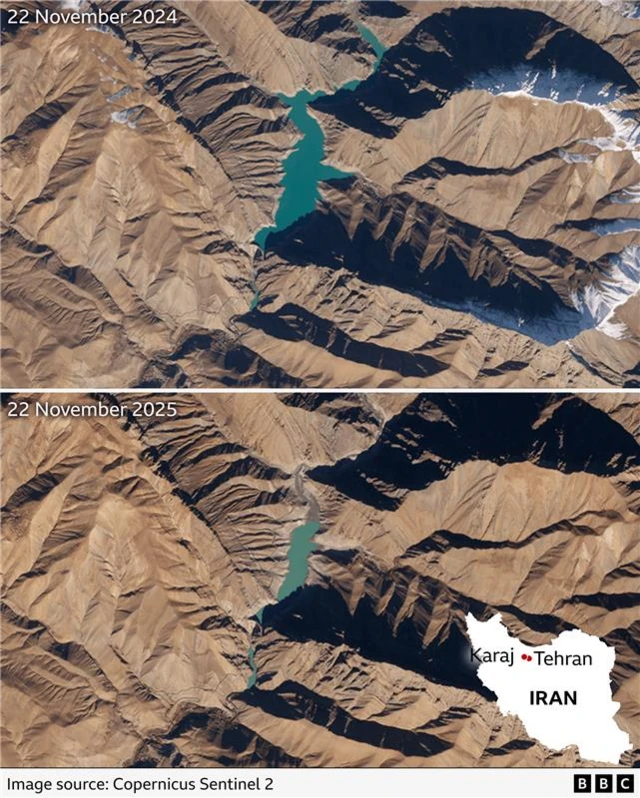
    Satellite images showing the Karaj reservoir (top) in November 2024 and (botton) November 2025 where it appears to have significantly less water

    Satellite imagery analysed by BBC Verify show water levels dropping at reservoirs serving Iran’s capital Tehran as it faces a water crisis.

    The city of around 10 million residents has had an unusually low level of rainfall this autumn, leading the authorities to warn that supplies may have to be rationed or restricted for several hours a day.

    Iranian President Massoud Pezeshkian said last month that the capital “must be relocated” if the current drought continues, warning that not doing so would “lead to a bleak future”.

    The city relies on five major reservoirs for its water supply: Karaj, Latyan, Taleqan, Lar and Mamloo.

    Mohsen Ardakani, head of Tehran’s water and wastewater company Abfa, said last month that the five reservoirs were only 11% full, down from 420 million cubic metres last year to 252 million this year.

    BBC Verify has analysed Sentinel-2 satellite imagery comparing water levels in Karaj reservoir - located 63km (39 miles) north-west of Tehran - on 22 November this year and last year. They show a significant fall in water levels this autumn.

  4. Videos show RSF fighters inside Sudanese army basepublished at 13:52 GMT

    Peter Mwai and Kumar Malhotra
    BBC Verify senior journalists

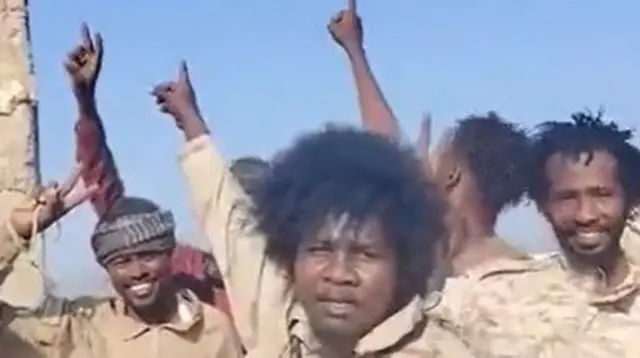
    A screengrab showing RSF fighters at the Sudanese army base in BanabusaImage source, X/@6a7a_hussein

    We’ve been verifying videos shared online by fighters from the Rapid Support Forces (RSF), which claim to show the paramilitary group in control of Sudanese military bases in Babanusa.

    Several videos posted on social media in the last 24 hours show RSF fighters celebrating inside the base of the Sundanese army’s 22nd division, next to a main road through the town in the central Kordofan region.

    The base’s sign, as well as buildings, trees and walls seen in the background, match Google Earth imagery.

    They also correspond to previous images of the base taken when it was under the control of Sudan’s armed forces.

    We’ve also verified videos showing RSF fighters at the base used by Sudan’s 89th brigade, located just to the north of the 22nd.

    The RSF has been targeting Babanusa for nearly two years, as it lies on a key route to the government-controlled city of el-Obeid in central Sudan.

    The paramilitary force has made a renewed push in the area following the capture of el-Fasher, the capital of North Darfur in late October. BBC Verify has previously investigated how RSF fighters carried out a massacre following the fall of the city.

    More than 150,000 people are estimated to have been killed in Sudan’s civil over the past two years.

  5. Debunking viral AI video of Venezuelan troops spotting warshipspublished at 13:08 GMT

    Jake Horton
    BBC Verify journalist

    A viral video showing Venezuelan troops spotting warships and planes off the country’s coast is AI-generated.

    The earliest version we could find was posted on TikTok a week ago and was labelled as AI, but it has now spread more widely without that label. The most viral version we’ve seen has more than two million views on X.

    The video shows troops dressed in military fatigues embroidered with the Venezuelan flag shouting at the camera as military aircraft and ships can be seen in the background.

    The fake footage has spread online amid a major US military build-up in the Caribbean, with the Trump administration issuing a series of threats against Venezuela’s government.

    BBC Verify has been tracking the movement of US warships over the last few months, which have moved closer to Venezuela but none have been spotted as close to the country’s coast as they appear in this video.

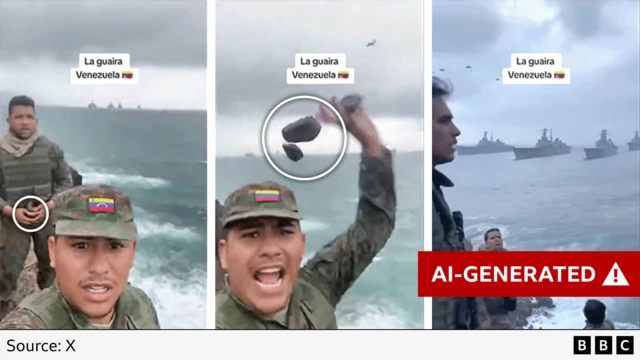
    There are several tell tale signs of AI-generation in the footage, including the hands of some of the troops appearing distorted and missing fingers. One soldier also throws a rock backwards which then disintegrates in mid air.

    A graphic with three screengrabs from the AI-generated video. The first shows a soldier with distorted hands, the second shows a different soldier throwing the rock backwards in an unnatural manner as it splits into several pieces and the third shows 4 warships within metres of the coast as a second group of soldiers look on.

    Plus, the video is three separate clips stitched together, each being exactly 10 seconds long. This is another likely sign of fakery, as most publicly available AI video generators can only create short clips of approximately that length.

  6. Are accidental prisoner releases on a ‘downward trajectory’?published at 12:37 GMT

    Anthony Reuben
    BBC Verify senior journalist

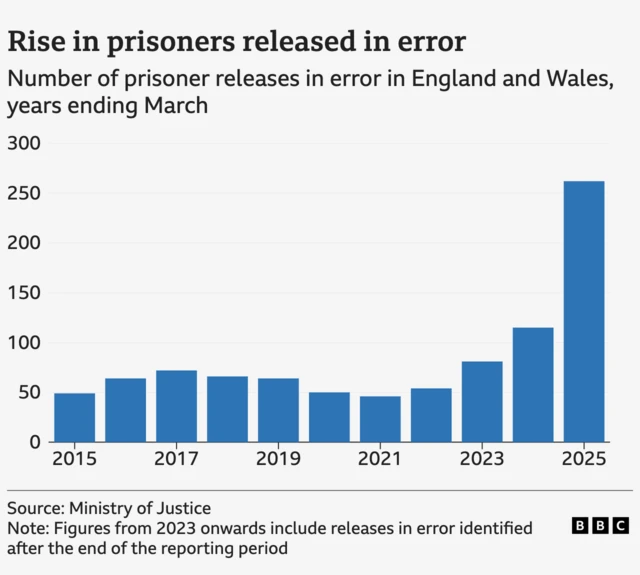
    Justice Secretary David Lammy told BBC Breakfast earlier that the number of prisoners accidentally released in England and Wales is on a “downward trajectory” following a series of high-profile incidents this year.

    “There has been a spike - it’s on a downward trajectory,” he said, before revealing that another 12 prisoners had been released in error since he made a statement to Parliament on 11 November. Two prisoners are still missing.

    He later said on BBC Radio 4 that he meant they were on a downward trajectory “based on last year’s figures”.

    You can clearly see a spike in the chart below.

    Since then, we’ve been told by the Ministry of Justice that there were 91 accidental releases, external between April and October 2025, which would be equivalent to about 155 a year (not allowing for possible seasonal effects).

    While this figure would be lower than last year’s spike, it would still be higher than in previous years.

    A bar chart showing the number of accidental releases from prisons in England and Wales from 2015 to 2025. The graph shows the number released in 2025 is more than double the figure for 2024
  7. Too early to say if Pokrovsk is fully under Russian control, says analystpublished at 12:05 GMT

    Olga Robinson and Emma Pengelly
    BBC Verify

    As we reported earlier, Russia has claimed to have taken control of Pokrovsk, so we’ve asked an expert to give their assessment of the situation in the heavily contested city in Ukraine’s eastern Donetsk region.

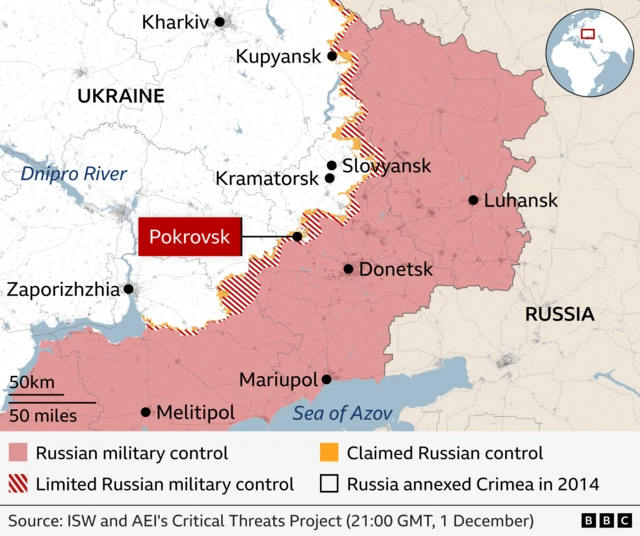
    Emil Kastehelmi, a military analyst and co-founder of the Black Bird Group which uses open source data to track the war, says Russia controls western and southern parts of Pokrovsk, but the situation elsewhere is unclear.

    He describes eastern and northern areas of the city as a “gray zone”, meaning neither side can fully claim it, according to information that is currently available.

    “Neither party likely has a clear control of the remaining districts and blocks. There would need to be further proof of Russia's success in the area in order to call Pokrovsk fully lost,” Kastehelmi adds.

    We’ve used data from the US-based Institute for the Study of War to map the area around Pokrovsk and other areas on the front line in Donetsk.

    Map showing where has Russian military control, limited Russian military control and claimed Russian control near Donetsk from 21:00 GMT on 1 December. Russian held areas are red, limited control is red and white stripes, claimed control is yellow and Ukraine held-areas are white. The map shows the area around Pokrovsk is all red and white or yellow.  The source is ISW and AEI’s critical threats project.
  8. Has resident doctors’ pay gone up or down?published at 11:32 GMT

    Nicholas Barrett
    BBC Verify researcher

    With a fresh strike by resident - or junior - doctors due to happen just before Christmas, this morning on BBC Radio 4’s Today programme there was a heated discussion about whether their pay has risen or fallen.

    The answer depends on how far back you go and what measure of inflation you use to calculate how their pay has been affected by rising prices over time.

    The doctors’ union - the British Medical Association - has looked at pay since 2008 and has used the retail price index (RPI) measure of inflation (which includes housing costs) to calculate how much it has been “eroded” by rising prices.

    RPI has been criticised for exaggerating price rises and lost its official statistics status in 2013, external.

    Using this measure, resident doctors’ pay was around 19% lower in 2024/2025 than it was in 2008, according to the Nuffield Trust health think tank, external.

    But using the standard measure of inflation, the consumer prices index (CPI), it was down around 7%.

    The government says resident doctors’ pay has risen and is using a different starting point - 2015 - and CPI.

    Since 2015, resident doctors’ pay has risen by 7.9% on CPI and fallen by 4.2% on RPI, according to the Nuffield Trust.

    Media caption,

    What’s happened to resident doctors’ pay since 2008?

  9. Satellite imagery shows massive flooding in Thailandpublished at 11:04 GMT

    Shruti Menon and Erwan Rivault
    BBC Verify

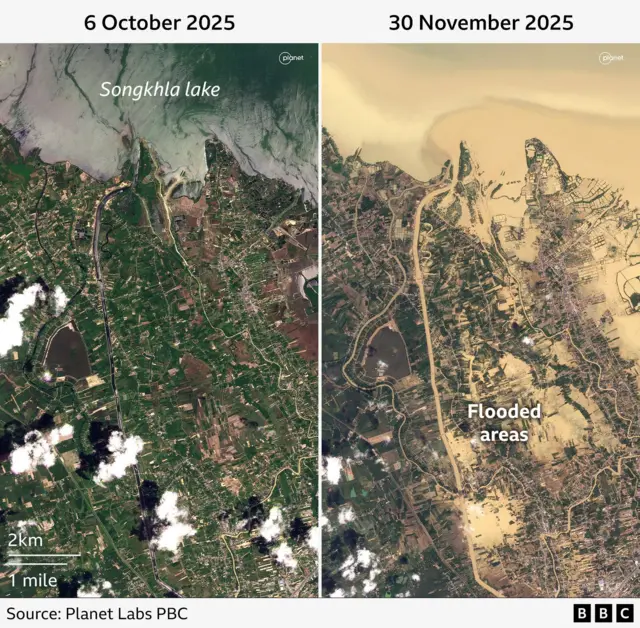
    New satellite imagery from Planet Labs shows extreme flooding in Thailand’s southern Songkhla province, one of the regions which has been worst-affected by heavy rainfall from cyclone Senyar.

    Yesterday, Thai authorities reported 176 deaths caused by flooding so far, 138 of which were in Songkhla.

    Images taken on Sunday show significant expansion of floods in populated areas and farmland around Songkhla lake, with the yellow-brown waters indicating high sediment concentrations caused by run-off.

    Before and after satellite images of an area near Songkla lake from 6 October and 30 November. The after photo shows large areas which were previously green or settlements are now coloured a yellow-brown by floodwater.

    Water levels have begun to recede now in some parts of Songkhla according to reporting by BBC Thai, but several areas in the province remain inundated.

    Data from Thailand’s Geo-Informatics and Space Technology Development Agency indicates nearly 96,000 acres of farmland has been affected in the province and over 300,000 people impacted.

  10. Russia claims control of key Ukraine city hours before peace talkspublished at 10:46 GMT

    Richard Irvine-Brown, Shayan Sardarizadeh and Emma Pengelly
    BBC Verify

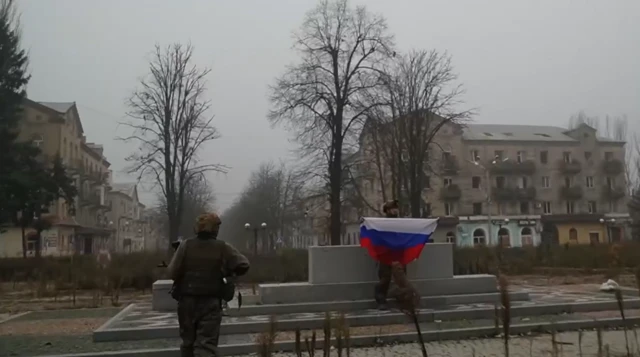
    Two soliders wearing camouflage are seen in a town square one of them holding the Russian national flagImage source, Telegram/Russian Ministry of Defence
    Image caption,

    A screengrab from the Russian MoD video apparently showing troops holding their flag in Pokrovsk

    Russia has claimed to have taken control of the city of Pokrovsk in eastern Ukraine hours before the US and Russia hold peace talks in Moscow.

    We’ve been looking at a video clip shared on Telegram by the Russian Ministry of Defence, as well as a longer version from a pro-Kremlin war blogger.

    The videos show Russian troops holding up a flag in Pokrovsk which is considered a key logistics hub due to its road and rail links.

    The city in Ukraine’s Donetsk region has been fiercely fought over for over a year, with recent months seeing incremental Russian gains in their efforts to occupy it. Some experts now contest how critical it is, due to the level of destruction brought about by fighting.

    The footage shows soldiers walking through heavily damaged central Pokrovsk and unravelling a Russian flag opposite the Donetsk National Technical University.

    It’s hard to determine from this video alone if Russians are in control of Pokrovsk. Videos from active combat zones can emerge online with a significant time lag and flag raising in itself does not constitute evidence of control of an area.

    Ukrainian forces fighting in Pokrovsk have denied Russia has seized the city, claiming to control the north still and that the Russian troops who raised the flag were beaten back shortly afterwards.

  11. Tuesday at BBC Verifypublished at 10:13 GMT

    Rob Corp
    BBC Verify Live editor

    We’ve been assessing footage shared by Russia’s Ministry of Defence claiming to show its troops raising their flag in the Ukrainian city of Pokrovsk. Moscow says it is in full control of the city - which has been fought over for more than a year. Ukraine says its forces still hold the north of the city so we’re working to get a better idea of what’s happening.

    We’ve received new satellite imagery which shows the impact of last week’s devastating flooding across south and south-east Asia. These images show how parts of southern Thailand were inundated after the intense rainfall.

    Elsewhere our fact-check team is looking ahead to an expected announcement on plans to restrict the right to trial by jury in England and Wales. Ahead of a statement from Justice Secretary David Lammy our team will set out some of the background on why the government says it has to act.

    You can send your questions to BBC Verify about the stories we’re covering or claims you’d like us to check via this link.

    BBC Verify banner