Summary

  1. Minister backs Rachel Reeves amid Budget criticismpublished at 15:53 GMT 1 December
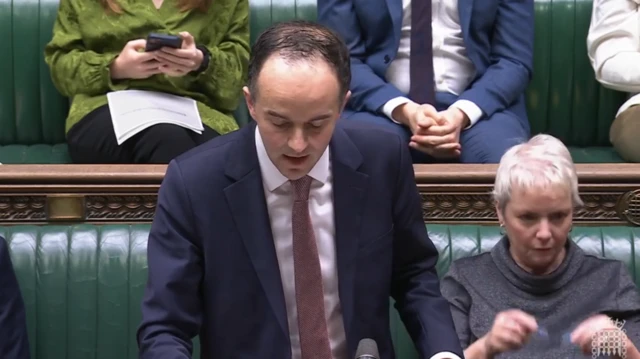
    James Murray is wearing a navy suit with a burgundy tie, whilst addressing the House of CommonsImage source, House of Commons

    Chief Secretary to the Treasury James Murray is standing in the House of Commons.

    He begins speaking about the Budget ahead of moving on to today's report from the OBR.

    Defending Rachel Reeves amid accusations she misled the public, Murray says the chancellor was consistent on her considerations.

    He said she was also clear on her priorities: cutting NHS waiting list times and reducing debt and borrowing.

    Murray then references the OBR's reduced productivity forecast - which showed a £16bn gap on 4 November - and says that Reeves knew she only had £4.2bn worth of headroom against her fiscal rules before she announced the Budget.

    In light of this information, Reeves knew "difficult decisions" would be needed on tax and spending rules, he adds - highlighted by the decision to freeze tax thresholds until 2031.

  2. Minister to speak on OBR in Commons - watch livepublished at 15:40 GMT 1 December

    Now the Office of Budget Responsibility (OBR) has published its report on the Budget error last week, we're about to hear the government's response.

    Chief Secretary to the Treasury James Murray will speak in the Commons shortly - you'll be able to watch live at the top of the page, and we'll bring you his comments here.

  3. 'This is wild': What happened when the OBR report was publishedpublished at 15:31 GMT 1 December

    Emily Atkinson
    Live editor

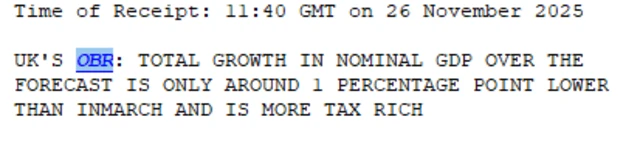
    A Reuters wire flash reading: "Time of Receipt: 11:40 GMT on 26 November 2025  UK'S OBR: TOTAL GROWTH IN NOMINAL GDP OVER THE FORECAST IS ONLY AROUND 1 PERCENTAGE POINT LOWER THAN INMARCH AND IS MORE TAX RICH"
    Image caption,

    The Reuters news agency began flashing figures and policies from the OBR report at 11:40 on Wednesday

    Rachel Reeves's second Budget was unlike any I've reported on previously.

    And not because of what she announced, but rather the unprecedented events that took place 40 minutes before she was due to speak.

    As we were preparing to cover the weekly session of PMQs at midday, the Reuters news agency began flashing numbers from the Office for Budget Responsibility (OBR), alongside details of policies we were expecting Reeves to announce.

    Highly unusual...

    Moments later, we learned that the OBR had published its economic and fiscal outlook early in error. How or why? We had no idea.

    (For the uninitiated, details of the Budget are supposed to be kept under wraps until the chancellor makes their statement due to market sensitivities.)

    "This is wild," was the verdict of the IFS's Helen Miller. And serious, too - we were, in essence, reading the Budget before the Budget had been announced.

    Cue frantic Googling.

    The document was not listed on the OBR website, but journalists - including us - were able to access it by guessing its URL, which was very similar to one used in a previous official document.

    We began searching the document for the expected announcements (a relatively simple task given the weeks of briefing and counter-briefing before the Budget) and sharing them - as fast as we could - on the BBC News website.

    PMQs had gone out the window (for us and the MPs furiously scrolling the OBR document on their phones).

    Before Reeves had risen to speak, we had reported the contents of the Budget almost in its entirety.

    Truly extraordinary.

  4. Key question is how well WordPress site is managedpublished at 15:27 GMT 1 December

    Liv McMahon
    Technology reporter

    Fingers on a laptop keyboardImage source, PA Media

    In the previous post we talked about the challenges encountered through the OBR's use of WordPress.

    WordPress is a content management system (CMS) used for creating and designing web pages.It's estimated to now run more than 40% of the internet’s websites.

    While incredibly popular, anyone who has used it before will be all too familiar with its many settings, possible plug-ins and configurations which are for some very simple, and for others highly confusing.

    Today’s OBR report says technical commentary often notes WordPress itself “can be onerous to configure and that mistakes are easily made in so doing".

    But its security will more often than not depend on how well it has been managed and configured – and that’s the key question here.

  5. How the OBR's 'worst failure' unfoldedpublished at 15:21 GMT 1 December

    Jack Grey
    Live reporter

    About an hour and half before Rachel Reeves was due to begin her Budget speech, the OBR sent its report, due to be published after the Budget, to its web developer which began uploading it to the OBR website.

    This was all planned, and these files should not have been accessible to the public, or any journalists, until officially published, however this was obviously not the case.

    The OBR uses WordPress to manage its website, which does in fact have systems in place to securely upload documents, for future publication, in a way that the files are not accessible until a desired time.

    OBR staff were under the assumption that even though the URL could be guessed, the protections provided by WordPress would ensure it could not be accessed, however, the OBR says two errors in how its website had been set up meant that this was not the case.

    A WordPress plug-in called Download Monitor created a web page with a URL that could be used to access the document, bypassing the need for authentication – a feature the OBR says was unknown to them.

    The second error was that the server hosting the website was not set up in a way to prevent access to files stored on it.

    The correct URL was guessed, first at 11:35 and then 43 more times up to 12:07 - when the files were renamed before being taken down, but at this point it was too late, it was out there.

    It confirms in the report that there was no "hostile cyber activity", it was just two mistakes - or in the OBRs own words "the worst failure in the 15-year history of the OBR" - in setting up a website.

    You can read the full report from the OBR here, external.

  6. How did journalists find the forecast early?published at 15:19 GMT 1 December

    The report says journalists were able to access the EFO early because they predicted what the URL - the internet address - of the OBR's document would be.

    In its report, the OBR says the URL followed a "clear pattern of addresses" from previous documents.

    For example, last year's outlook was published under a URL containing 'OBR_Economic_and_fiscal_outlook_Oct_2024'.

    Last week's document was similarly titled 'OBR_Economic_and_fiscal_outlook_November_2025'.

    This means you could access the page even if it wasn't searchable by simply guessing what the URL could be.

  7. Thirty-three minutes til take-down: a timeline of the report's mistaken releasepublished at 15:12 GMT 1 December

    According to the OBR's report, it took 33 minutes from the Economic and Fiscal Outlook (EFO) document being first accessed until it was taken down. Here's how it played out:

    • Between 5:16 and 11:30, 44 unsuccessful requests are made to the URL where the OBR's document will be later uploaded
    • 11:02: the EFO documents are emailed to the web developer and begin to be uploaded to the website at 11:30
    • 11:35: the first successful request to the site is made - meaning the report is accessible
    • 11:41: Reuters news agency sends a news alert about the OBR's outlook, saying there would be £26.1bn tax rises by 2029-30
    • 11:43: OBR staff are made aware by a non-Reuters journalist that "extensive details" were being published
    • 11:52: Treasury officials tell OBR staff that the EFO document was accessible through its URL - and staff attempt to take the website down
    • 12:08: the EFO document is removed from the website - after briefly appearing on internet archive and being accessed 43 times
    • 13:38: Chancellor Rachel Reeves finishes her Budget statement, and the documents are released again
  8. OBR's March forecast also 'accessed prematurely'published at 15:07 GMT 1 December

    The OBR's previous economic forecast in March was also "accessed prematurely on one occasion", the report says.

    There is "no evidence of any activity being undertaken as a result of that access", the OBR, says, but it adds the discovery is "of concern".

    The OBR says it is "essential that a more detailed forensic digital audit of some of the most recent fiscal events is undertaken".

    This should allow it to understand whether there have been other cases of "premature access".

  9. OBR cannot carry out review on its own, report sayspublished at 14:59 GMT 1 December

    The OBR says given the small size of the organisation, it used a web developer from a government framework who helped to manage and upload content at times of pressure.

    "The risks associated with this approach have increased as technologies have developed and with the rise in online threats", and the OBR says this arrangement should have been regularly re-examined.

    The report says the OBR should carry out a full review into whether it continues to be appropriate for it to maintain its own entirely separate online publishing operation.

    "It should not attempt to carry out these tasks on its own, but form a working party involving the leadership of the technology and communications communities within government", the report adds.

  10. System must be overhauled by spring - OBRpublished at 14:49 GMT 1 December

    To have prevented the early release, the report says a solution would have been to move the OBR's "entire online publishing operations" onto the government's website instead of its own.

    It says in this instance the government would provide the digital architecture, which the OBR would then publish documents onto.

    Another solution, the report adds, would be to hand the publication over to the Treasury itself.

    "Whatever decision is taken, new arrangements must be put in place in good time for the Spring 2026 EFO," the OBR report reads.

    For context, the Economic and Fiscal Outlook (EFO) report produced by the Office for Budget Responsibility is scheduled to release in Spring 2026.

  11. OBR to 'rebuild trust' by immediately changing publishing arrangementspublished at 14:46 GMT 1 December

    The report says the leadership of the OBR "must take immediate steps" to overhaul how it publishes the "important and time-sensitive documents", which are those containing the results of its biannual forecasts that it publishes in a normal year.

    It says it must also review arrangements for all other publications.

    The report says such action is necessary to "rebuild trust".

  12. Report error not 'result of hostile cyber activity'published at 14:41 GMT 1 December

    The report also states that the early release was not the "result of hostile cyber activity" by any foreign actors, criminals or anyone working at the OBR.

    Instead, the report states the cause appears to have been "configuration errors which reflected systemic issues".

    There was a failure to hide documents from public view immediately before publication, the OBR says.

    The document was accessible via a URL that was "predictable" because it followed a "clear pattern of addresses" from previous reports.

    We'll continue to bring you further details.

  13. OBR says mistaken release 'worst failure' in its 15-year historypublished at 14:39 GMT 1 December

    In its report, the Office for Budget Responsibility calls last week's early forecast release "the worst failure in the 15-year history of the OBR".

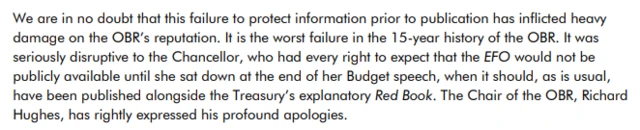
    "It was seriously disruptive to the Chancellor, who had every right to expect that the EFO [economic and fiscal outlook] would not be publicly available until she sat down at the end of her Budget speech," the report says.

    It says the release "should, as is usual, have been published alongside the Treasury’s explanatory Red Book".

    We are in no doubt that this failure to protect information prior to publication has inflicted heavy damage on the OBR’s reputation. It is the worst failure in the 15-year history of the OBR. It was seriously disruptive to the Chancellor, who had every right to expect that the EFO would not be publicly available until she sat down at the end of her Budget speech, when it should, as is usual, have been published alongside the Treasury’s explanatory Red Book. The Chair of the OBR, Richard Hughes, has rightly expressed his profound apologies.Image source, OBR
    Image caption,

    The section of the OBR report that calls it the "worst failure" in its 15 year history

  14. Economic forecast 'not intentionally leaked', OBR sayspublished at 14:37 GMT 1 December
    Breaking

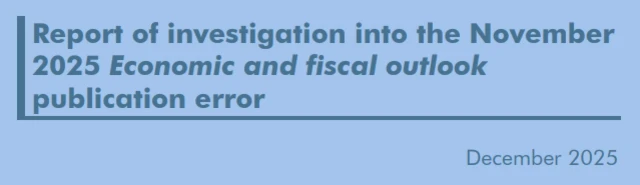
    The report from the Office for Budget Responsibly (OBR) that released Budget details prematurely was not "intentionally leaked" and not a case of button being pressed "too early", the organisation says in a report.

    We've just received the report, we're working through it now and we'll bring you all the key points here.

    Headline of report that says: Report of investigation into the November 2025 Economic and fiscal outlook publication error -Image source, OBR
    Image caption,

    The OBR has published a report into how it published details of Reeves' Budget before she spoke to Parliament

  15. OBR about to release report into Budget publishing errorpublished at 14:28 GMT 1 December

    The Office for Budget Responsibility said on X this morning it would be releasing a report into its Budget day publishing error at 14:30.

    Last week, the OBR released its economic forecast less than an hour before Chancellor Rachel Reeves announced the Budget.

    The 203-page document included details of the policies she was about to announce. The forecast is usually published hours after the chancellor's statement.

    Shortly after, the OBR released a statement blaming a "technical error". The forecaster's chairman Richard Hughes said he was "personally mortified".

  16. Budget talk can be confusing - let's break it down in less than 200 wordspublished at 14:20 GMT 1 December

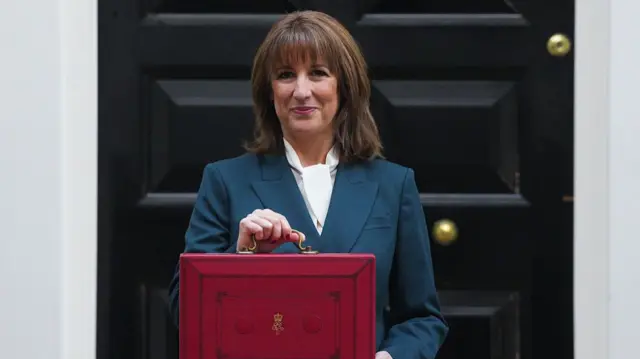
    Rachel Reeves stands outside No 11 Downing Street holding the iconic red briefcase.Image source, Getty Images

    We've heard a lot of financial terms today. Here's a reminder of what some of them mean.

    Office for Budget Responsibility (OBR): an independent body that assesses the economy’s health. When the Budget is released, the OBR makes a forecast for the next five years.

    Fiscal headroom: the flexibility the government has to increase spending or cut taxes. More headroom means improves market confidence.

    Productivity performance: the amount of goods and services the entire UK economy produces for each hour of work done by everyone who works, also known as "output per hour".

    Higher levels of productivity often means higher wages and incomes.

    What comes under welfare spending? Over half of families receive income from at least one benefit in the welfare system - from pensions, benefits, to Jobseeker's Allowance. Changes to welfare spending could affect the amount of people receiving each payment.

    Two-child cap: Labour has just scrapped the two-child benefit cap, which meant parents could only claim universal credit or tax credits for their first two children.

  17. Starmer backs his chancellor as Reeves insists her job is safepublished at 13:58 GMT 1 December

    If you're just joining us, or need a catch-up, here's a summary of what's been happening today:

    We're also expecting the Office for Budget Responsibility (OBR) to publish a report later after it last week mistakenly released its Budget assessment early. Stick with us.

  18. Reeves was right to be wary ahead of Budget, insists Labour MPpublished at 13:50 GMT 1 December

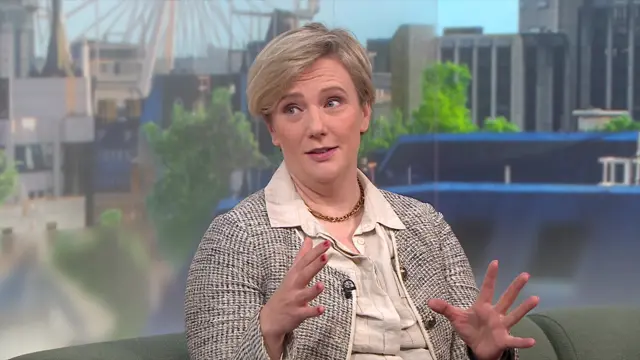
    Stella Creasy sitting down on a green couch wearing a black and beige blazer and beige shirt, her hands raised as she gesticulates mid-speech

    Labour MP Stella Creasy insists Rachel Reeves was not misleading the public in the lead up to her Budget announcement, adding to the ranks of those defending the chancellor.

    "I think this is the reality of a very uncertain economic condition," Creasy tells the BBC.

    Creasy says it is "right and prudent to be wary", and to have more "headroom" - or financial buffer - in a global economy where there are "lots of uncertainties".

    For context, Reeves is accused of not giving the upsides to forecasts in a speech on 4 November.

    "What I look at is what the chancellor is actually doing. Some things are absolutely right... some things I want to work on," the backbencher says.

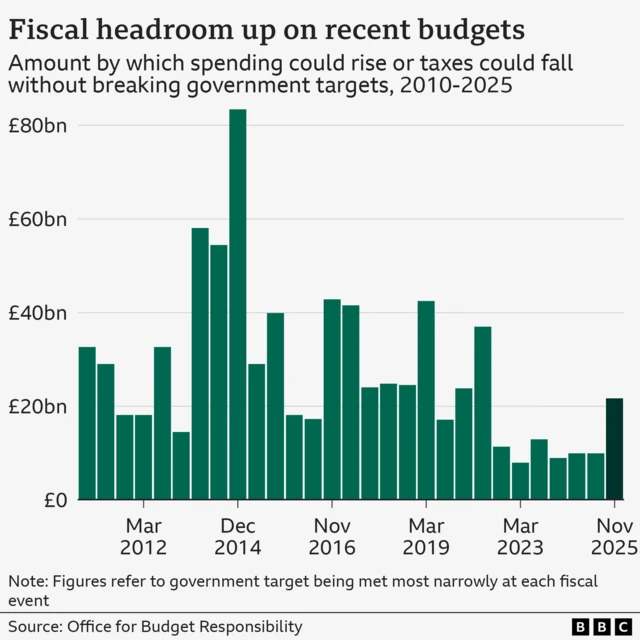
    A bar chart showing fiscal headroom at each budget or fiscal event since 2010. Headroom was £22 billion in November 2025, up from £10 billion in Rachel Reeves' Spring statement and last Autumn budget. Headroom peaked at around £83 billion in 2014. Fiscal headroom is the amount by which spending could rise or taxes could fall without breaking the government's fiscal rules. Figures refer to the government rule being met most narrowly at each fiscal event.
    Image caption,

    On Sunday, Reeves said she "clearly could not deliver a budget with just £4.2bn of headroom... that is why I took those decisions to get that headroom up to £21.7bn"

  19. We asked you about Starmer's speech. Here's what you saidpublished at 13:24 GMT 1 December

    The BBC's 'Your Voice' banner appears with white, graffiti-style text against a red background.

    Earlier today, we asked you for your thoughts on Keir Starmer's speech, in which he defended both his chancellor and her Budget.

    Here's what you had to say:

    • I find the prime minister's speech entirely unconvincing. It is just a repeat of the hastily composed flannel that has been reiterated since last Wednesday. It does nothing to address the fact that we have a thoroughly dishonest chancellor who appears incapable of being transparent with the public - Francis Topping, Bishops Waltham
    • I believe that is clear from what she said in her interview both with Laura Kuenssberg and with Sky that Rachel Reeves told lies in her run up to the Budget, during and after the Budget. I also believe that in supporting her throughout that process that the prime minister was complicit in those lies - Geoff Green
    • Removing the two-child benefit cap is good but they could have done more for the millions in poverty, and the claims this budget is for benefit street is bogus - Catherine, south-west London
    • This is just one error of judgement too many from this hapless chancellor. She has forfeited our trust and should go - Alan Whitworth, Wiltshire
  20. Reeves: I'm absolutely confident I'll be chancellor at next electionpublished at 13:06 GMT 1 December

    Rachel ReevesImage source, PA Media

    Over in Newport, south Wales, Rachel Reeves has been chatting to reporters on the sidelines of an investment summit.

    Pushed on accusations she misled the public about the state of the nation's finances before the Budget, Reeves insists she is "proud" of the measures she announced last week.

    Opponents - including leader of the opposition Kemi Badenoch - have called for Reeves to resign, but she says she's "absolutely confident" that she will be chancellor by the next election.

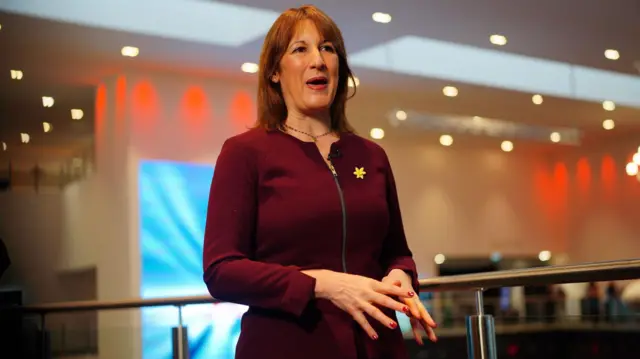
    "I set out in a speech a couple of weeks before the Budget that the ambition for the Budget was to cut NHS waiting lists, cut the cost of living, and cut the debt and the deficit," she says. "We've achieved all of those things."

    She also says that using taxes to increase the government's headroom gives the country "the best shot of withstanding all of the volatility that we're seeing in the global economy at the moment".