OBR head resigns over Budget day publishing error
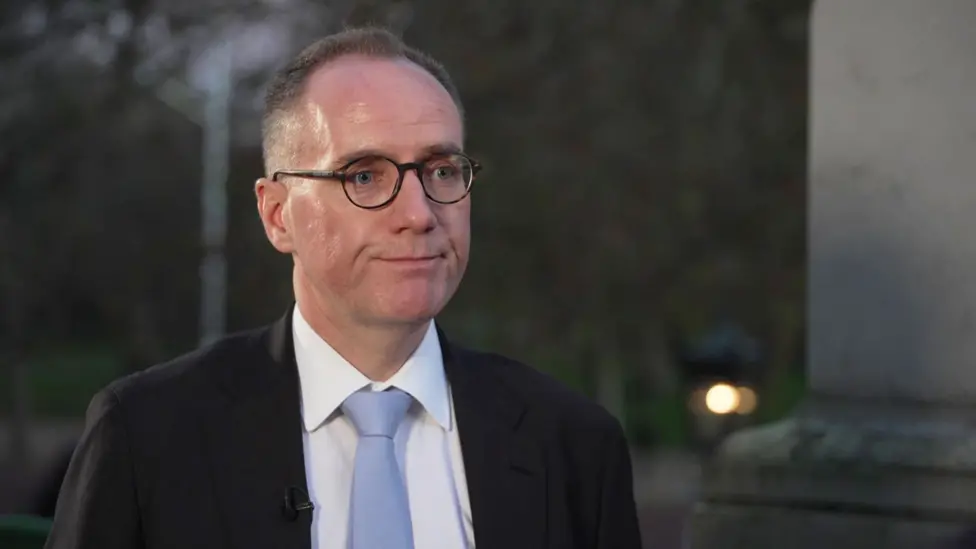
Chair of the OBR Richard Hughes said he took "full responsibility" for the shortcomings identified in the report
- Published
The chairman of the Office for Budget Responsibility (OBR) has resigned following the Budget day error which saw a key document published early.
Richard Hughes said in his resignation letter, external he took "full responsibility" for the issues that were identified in the OBR's investigation into the mistake.
That investigation found the early publication of the OBR's forecasts was the worst failure in the organisation's 15-year history.
The UK's official forecaster confirmed the market-sensitive report was accessed 43 times from 32 different devices in the hour before the chancellor's speech.
In a letter sent to both the chancellor and the chair of the Treasury Select Committee, Dame Meg Hillier, Mr Hughes said he believed the OBR could "quickly regain and restore the confidence and esteem" it had earned by implementing the report's recommendations.
"But I also need to play my part in enabling the organisation that I have loved leading for the past five years to quickly move on from this regrettable incident," he continued.
"I have, therefore, decided it is in the best interest of the OBR for me to resign as its Chair and take full responsibility to the shortcomings identified in the report."
Mr Hughes had been due to face questions from the Treasury Select Committee on Tuesday about the Budget and the OBR's economic forecasts, but Dame Meg confirmed that he would no longer attend.
In response to his resignation, Chancellor Rachel Reeves said: "I want to thank Richard Hughes for his public service and for leading the Office for Budget Responsibility over the past five years and for his many years of public service."
But Conservative Party leader Kemi Badenoch accused the chancellor of "trying to use the chair of the OBR as her human shield".
Paul Johnson, the former director of the Institute for Fiscal Studies and provost at Queen's College, Oxford said he was not surprised Mr Hughes had resigned.
"That was a really bad mistake," he told BBC News, but added that Mr Hughes had been a "very effective and very robust" head of the OBR.
"I think it's a shame for Richard Hughes and a shame for the OBR."
Mr Hughes had only recently started his second five-year term as OBR chairman, after being renominated by the chancellor in May. He first took up the job during the Covid pandemic in October 2020.
Prior to that, he had been director of fiscal policy at the Treasury, and earlier he was the division chief of the International Monetary Fund's fiscal affairs department for eight years.
Has Britain's budget watchdog become too all-powerful?
- Published6 days ago
Earlier, Sir Keir Starmer denied the chancellor had misled the public about the state of the nation's finances ahead of last week's Budget.
Reeves had given strong indications in the lead-up to the Budget that she was planning to increase income tax rates, pointing to gloomy forecasts for economic productivity.
But on Friday, the OBR revealed it had told the Treasury earlier that its downgrade to productivity would be offset by higher incomes, which would boost the government's tax receipts.
Asked on Monday whether Reeves had been misleading, Sir Keir said the government had committed to a number of things including cutting borrowing which meant the government "would always have to raise revenue".
'Worst failure'
Following the Budget day leak, Mr Hughes called in a leading cyber-security expert to investigate how the crucial document was put on its website too early.
On Monday the report into the mishap, external concluded it had "inflicted heavy damage on the OBR's reputation" and had been "seriously disruptive" to the chancellor, but added that it was inadvertent.
The "ultimate responsibility" for the circumstances which meant people could access the report early lay with the OBR's leadership, the report added.
"It is the worst failure in the 15-year history of the OBR," it said.
Monday's report also found that somebody gained early access to the equivalent financial forecasts in March while Reeves was delivering her Spring Statement, though they did not act on the information.
The chancellor's Budget was thrown into chaos when the OBR's forecast was discovered online.
The OBR assesses the health of the UK's economy. It is independent of the government but works closely with the Treasury.
Its reports are released alongside big government events such as the Budget, details of which are supposed to be kept under wraps until the chancellor announces them in the House of Commons.
The OBR's early publication effectively confirmed a number of new measures, including a pay-per-mile charge on electric vehicles, and a three-year freeze on income tax and National Insurance thresholds, before the chancellor announced them.
Pre-existing weakness
The OBR brought in Ciaran Martin, the former chief executive of the National Cyber Security Centre, to lead the investigation into how the forecasts were accessed early.
However, the OBR concluded there was no reason to suspect the involvement of foreign actors or cyber-criminals, or of "connivance by anyone working for the OBR".
In his investigation, Prof Martin found:
the OBR analysis was available at a hidden URL between 11:30 and 12:08 on the morning of the Budget
an attempt was made to access the URL as early as 05:16
this was a pre-existing weakness in the OBR publication system, demonstrated by the premature access to March's forecasts
early publication was related to the software the OBR chose to publish to its website, which was more suitable for a small or medium company than a major publication of critical market-sensitive data
While OBR staff thought they had applied safeguards to prevent early publication, there were two errors in the way in which they were set up on the publishing platform WordPress that effectively bypassed these controls.
One was to do with a plug-in (an optional extra) the OBR had installed, which had the unintended effect of bypassing the need to log in to access documents intended for future publication.
The second was the directory in which the file was put ahead of publication allowed anyone to download a file directly.
The OBR got an exemption in 2013 from using a more secure government publishing platform for independent authorities in order to help with its autonomy. In other IT security areas, such as secure email, the OBR had adopted the secure Treasury systems.
A Treasury spokesperson thanked the OBR for its report and said a minister would respond "in due course".
Get in touch
Do you have any views, comments or questions about this story?